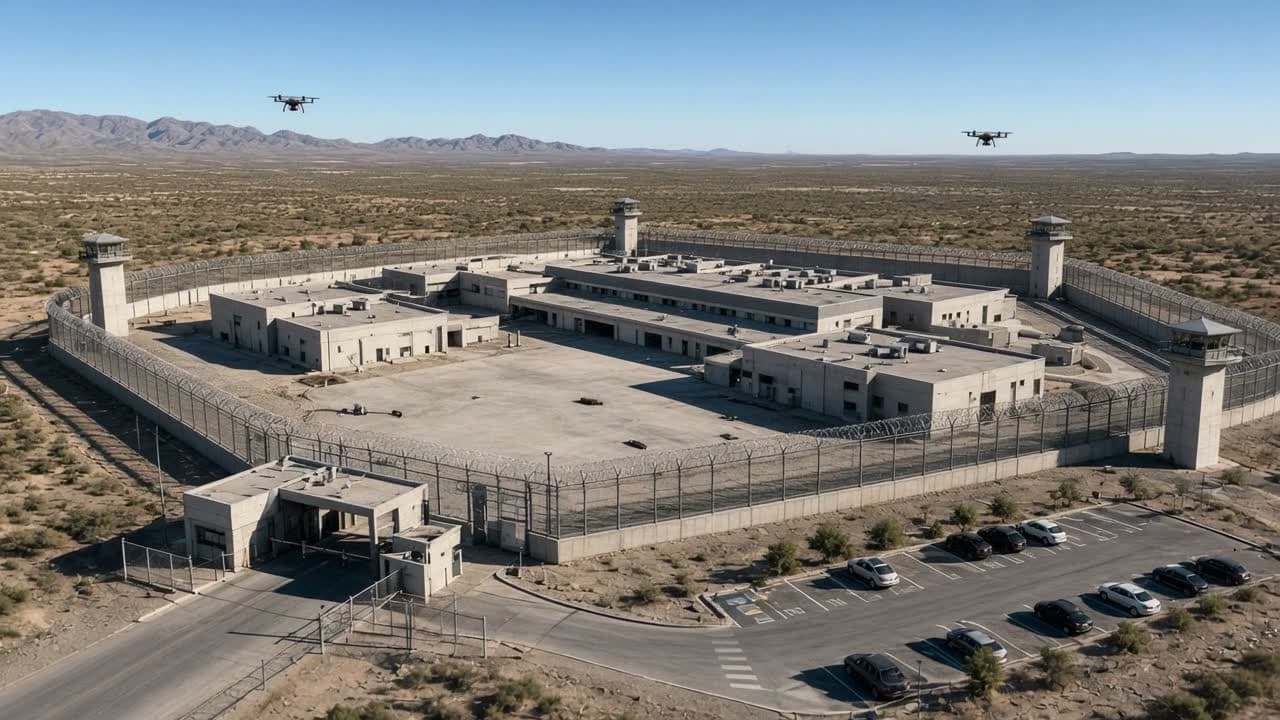
Correctional Facility Airspace Security
The Fence No Longer Defines the Perimeter.
Walls, gates, checkpoints and guard towers are designed to stop people and vehicles.
Drones fly over all of them.
SkyLock-X gives correctional and secure-facility teams persistent low-altitude awareness to detect, classify and assess drone activity before contraband, surveillance or other unauthorized activity reaches the protected area.
Passive RF Detection · Real-Time Classification · Direction Finding · BeHave™ Intelligence · Multi-Sensor Integration
The Problem
Aerial Perimeter Bypass — Drones Can Cross a Secure Perimeter in Seconds.
Correctional institutions depend on layered physical security.
But a drone carrying a small payload does not need to pass a gate, vehicle inspection or security checkpoint.
It can approach from outside the property and deliver directly into a secure area.
Contraband Delivery
Drones can be used to carry phones, drugs, weapons and other prohibited items over perimeter barriers.
Perimeter Reconnaissance
Unauthorized aircraft can observe guard positions, inmate activity, patrol procedures and physical-security infrastructure.
Repeat Delivery Routes
The same operators may return to familiar launch locations, drop zones or operating windows.
Coordinated Activity
Drone events can coincide with inmate movement, shift changes or other activity inside the facility.
Operator Evasion
A drone operator may launch from outside the facility boundary and leave before officers can establish where the aircraft originated.
Limited Response Time
Once the aircraft crosses the perimeter, security personnel may have only a short period to respond before the payload is released.
The objective is simple: detect the activity before the delivery reaches the facility.
From Perimeter Breach to Early Warning
See the Approach Before the Drop — Give Security Teams More Time to Respond.
SkyLock-X provides an additional security layer beyond the fence.
01 — Detect
Continuously monitor relevant RF activity around the facility for communications associated with drones and their controllers.
02 — Classify
Analyze detected signals and identify supported communication protocols, aircraft categories and relevant RF characteristics.
03 — Identify
Combine RF information, available Remote ID and other supported sources to create additional context around the event.
04 — Locate
Use direction finding and multi-sensor configurations to estimate the direction or location of selected RF sources when enhanced localization is required.
05 — Assess With BeHave™
Compare current activity with previous detections around the facility to identify recurrence, unusual timing and recognizable operating patterns.
06 — Alert
Notify officers or security personnel before the aircraft reaches the protected area whenever detection range and operating conditions allow.
07 — Respond
Give facility personnel actionable information to investigate the event, protect the potential drop area and coordinate an authorized response.
Earlier Detection Creates More Response Time.
The Contraband Problem
The Payload May Be Small. The Consequences Are Not.
What Crosses the Fence Can Change Security Inside It.
A small drone can carry items that create significant security problems once they enter a correctional environment.
Potential payloads can include:
- mobile phones
- narcotics
- weapons and components
- tools
- communication devices
- other prohibited material
The security impact may extend far beyond the value of the item itself.
A single successful delivery can contribute to illicit communications, organized criminal activity, violence or further coordinated security breaches.
SkyLock-X is designed to move the detection point away from the drop zone and toward the approaching aircraft.
BeHave™ for Correctional Facilities
Detect the Pattern, Not Just the Drone.
Contraband Flights Rarely Exist in Isolation.
One drone event is useful information.
Repeated activity creates intelligence.
BeHave™ analyzes historical detections and available event data to help security teams identify recurring patterns around the facility.
Recurring RF Signatures
Identify signal characteristics appearing across multiple events.
Repeated Launch Areas
Correlate direction-finding or location information that may indicate recurring activity from similar external areas.
Drop-Zone Patterns
Identify repeated approaches toward the same part of the facility.
Timing Patterns
Surface activity occurring around similar hours, inmate movement periods, shift changes or operational windows.
Event Correlation
Compare new detections with previous incidents to identify similarities requiring additional attention.
Risk Prioritization
Help security personnel distinguish isolated events from recurring activity that may indicate a coordinated contraband operation.
From detecting a drone to understanding how the operation may be repeating.
Find the Operator, Not Just the Aircraft
Direction Finding & Geolocation.
The Drone Is Only One Part of the Event.
In many correctional incidents, the operator remains outside the facility perimeter.
Detecting the aircraft is important.
Finding the likely direction or location of the control signal can provide security and law-enforcement personnel with additional information for investigation.
SkyLock-X can incorporate direction-finding capabilities to support:
Operator Direction
Estimate the bearing of selected drone-control or RF signals.
Multi-Sensor Localization
Use measurements from multiple appropriately positioned systems to support enhanced source localization.
Event Mapping
Associate direction and location information with the detection event.
Historical Correlation
Compare recurring locations or bearings with previous activity around the facility.
Law-Enforcement Coordination
Provide available event information that can support investigation by authorized personnel.
Protect the facility — and understand where the activity may be originating.
Beyond Remote ID
Unauthorized Activity May Not Cooperate.
A Security System Shouldn't Depend on the Aircraft Identifying Itself.
Remote ID can provide valuable information when usable identification data is available.
But correctional security cannot assume that every aircraft involved in unauthorized activity will provide the expected information.
SkyLock-X adds passive RF analysis of supported drone communications to the security picture.
This gives officers another source of awareness when cooperative identification is unavailable or incomplete.
Multi-Layer Facility Security
Add Airspace Awareness to the Security You Already Have.
The Drone System Should Be Part of the Facility — Not Another Isolated Console.
SkyLock-X can integrate into existing correctional security operations.
Security Control Room Integration
Deliver alerts and events to personnel already monitoring the facility.
Existing Camera Systems
Use available EO/IR or surveillance cameras to support visual verification after detection.
Direction Finding
Add bearing information where locating the aircraft or operator becomes operationally important.
Radar Integration
Combine RF intelligence with physical object detection where required.
Open API
Feed SkyLock-X data into existing command-and-control or security-management systems.
Event History
Preserve detections, alerts and supporting information for later investigation.
One more security layer — integrated with the ones already in place.
Multi-Facility Intelligence
Protect More Than One Institution.
Recurring Activity May Not Stop at One Facility.
Correctional agencies and private operators often manage multiple institutions.
SkyLock-X can consolidate detections across facilities into a common operational environment.
Security teams can compare:
- recurring RF signatures
- similar approach patterns
- repeated operating times
- events around multiple institutions
- historical incident activity
- priority alerts
This can help identify patterns that are difficult to recognize when each facility analyzes incidents independently.
Individual sites become part of a broader airspace-intelligence network.
Response & Authorized Mitigation
Detect Early. Respond Through Established Procedures.
Awareness Comes First.
For correctional operators, the immediate value is earlier information.
When a drone event is detected, personnel can:
- protect likely drop areas
- increase observation of affected zones
- coordinate facility response
- preserve event evidence
- support operator investigation
- coordinate with law enforcement
- adjust security procedures around recurring activity
Active counter-UAS mitigation technologies may be available to government agencies and other appropriately authorized users where their use is legally permitted.
Real-World Experience
Designed Around Adaptive Drone Threats.
Operators Change Their Methods. Detection Has to Keep Up.
Commercial drones can be modified.
FPV systems evolve.
Communication methods change.
Operators adapt after successful interdiction.
SkyLock-X is informed by real-world experience in environments where drone technology and operating methods evolve rapidly.
We apply that experience to correctional security through:
- Detection of evolving RF-controlled systems
- Recognition of known and emerging communication methods
- Historical event intelligence
- Operator direction finding
- Multi-sensor integration
- Adaptable deployment architectures
Operational drone experience applied to correctional security.