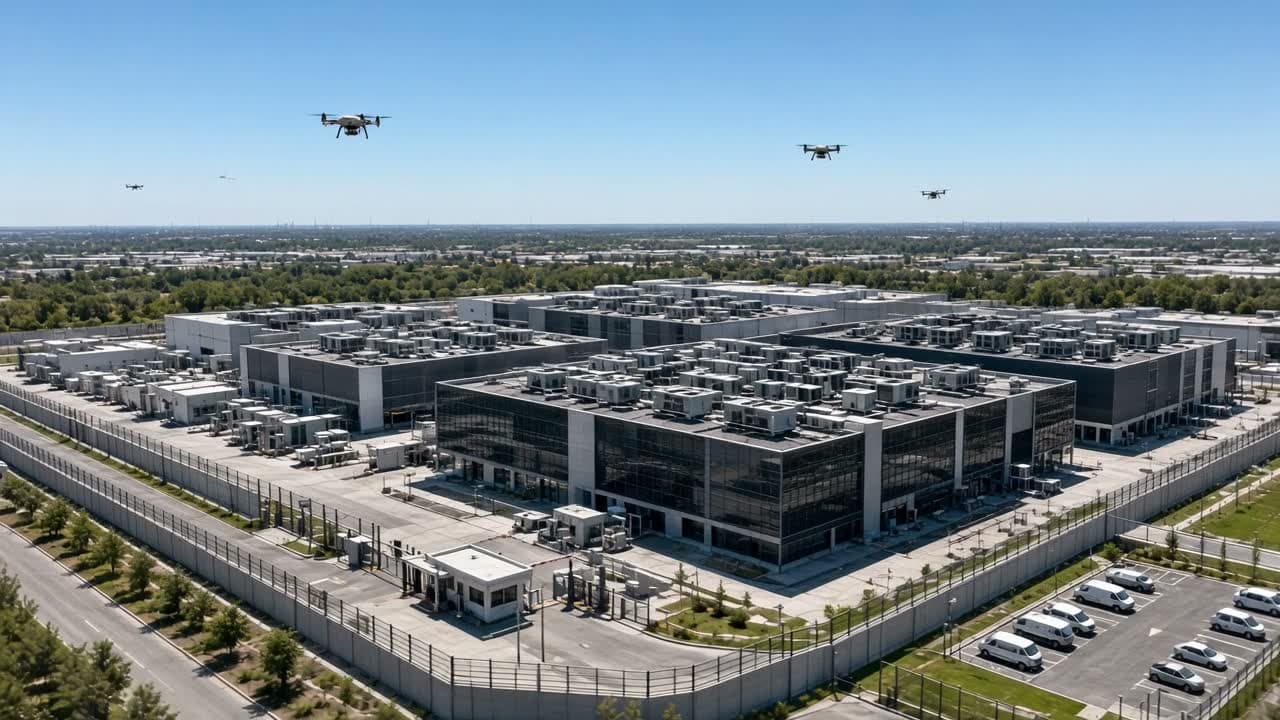
Data Center Airspace Security
Your Data Center Is Secure. Is the Air Above It?
Data centers are built around layered physical and cybersecurity.
But a drone can observe critical infrastructure, personnel, access patterns and operational activity without ever crossing the fence.
SkyLock-X adds persistent low-altitude airspace intelligence to existing data-center security — detecting, classifying and analyzing drone activity before it becomes a security or operational concern.
Passive RF Detection · Real-Time Classification · BeHave™ Intelligence · Direction Finding · Secure On-Premise Deployment
An Aerial Surveillance Blind Spot
Sensitive Infrastructure Can Be Observed Without Entering the Property.
Data centers invest heavily in gates, cameras, access controls, guards and cybersecurity.
Those systems are designed primarily to control access at ground level.
Drones change the equation.
A small unmanned aircraft can observe large portions of a facility from outside its physical perimeter and collect information that would otherwise require direct access to obtain.
Infrastructure Reconnaissance
Observe cooling systems, generators, electrical infrastructure, rooftop equipment, communications assets and other externally visible systems.
Security Mapping
Monitor entrances, guard positions, camera coverage, service areas and recurring security procedures.
Personnel & Vendor Observation
Identify employee, contractor, supplier and delivery patterns around sensitive facilities.
Construction Intelligence
Capture aerial views of facilities under construction or expansion, potentially revealing site configuration before the location becomes fully operational.
Repeated Surveillance
Return over multiple days or operational windows to build a more complete understanding of facility activity.
Operational Disruption
Unauthorized drones near sensitive infrastructure can create uncertainty, trigger security responses or potentially interfere with exposed technical systems.
The risk is not simply that someone sees the building. It is what repeated observation can reveal.
High Security. High Consequence. Low Tolerance for Uncertainty.
Airspace Security Must Fit the Data-Center Environment.
A data-center security system cannot become another source of operational or cybersecurity risk.
SkyLock-X is designed around environments where security architecture, data ownership and system integration matter as much as detection performance.
Passive Detection
Core RF monitoring operates by receiving relevant radio-frequency activity rather than continuously transmitting a detection signal toward the airspace.
Customer-Controlled Infrastructure
Processing and storage can be designed around customer-controlled environments and internal security policies.
On-Premise Deployment
Detection data and event history can remain inside the customer's infrastructure where required.
Air-Gapped Architecture
Deployments can support environments where continuous external connectivity is restricted or prohibited.
Existing SOC Integration
Drone events can become part of the security operation already protecting the facility rather than creating a separate monitoring workflow.
Multi-Site Security
Organizations operating multiple data centers can consolidate airspace information across facilities into a common operational view.
From Detection to Decision
Actionable Airspace Intelligence.
SkyLock-X turns drone-related RF activity and available sensor information into operational intelligence for security teams.
01 — Detect
Continuously monitor relevant RF activity around the facility for communications associated with drones, controllers and unmanned systems.
02 — Classify
Analyze signals to distinguish relevant drone activity from ordinary Wi-Fi, cellular and other RF background activity and identify supported protocols and aircraft categories.
03 — Identify
Correlate RF characteristics, Remote ID and other available information to build greater context around the detected event.
04 — Locate
Add direction finding, multi-sensor localization or complementary sensor information when the deployment requires enhanced source location.
05 — Assess With BeHave™
Compare the event with previous activity around the facility. BeHave™ analyzes timing, recurrence, RF characteristics, available location information and historical patterns to help identify unusual activity and prioritize security attention.
06 — Alert & Integrate
Deliver relevant information to security personnel or into existing security-management and command systems.
07 — Respond
Give the security team the context needed to investigate activity, apply established procedures and coordinate an appropriate response.
Detection Becomes Security Intelligence.
BeHave™ for Data Centers
When Repeated Activity Changes the Risk.
One Flight May Be Curiosity. A Pattern Deserves Attention.
A single drone flight near a data center does not automatically indicate malicious intent.
But context matters.
Consider activity that repeatedly appears:
- near the same infrastructure
- during employee shift changes
- around delivery or maintenance windows
- during construction activity
- from similar locations
- with a recurring RF signature
- or at multiple facilities within the same portfolio
Individually, those events may appear unrelated.
Together, they may justify additional attention.
BeHave™ helps security teams identify those relationships.
Site-Specific Baselines
Establish a historical picture of drone activity around each protected facility.
Recurrence Detection
Identify repeated RF signatures, approaches and activity patterns.
Temporal Analysis
Surface events that repeatedly occur during particular hours, days or operational windows.
Anomaly Detection
Flag changes from previously observed activity around the site.
Cross-Site Analysis
Compare observations across multiple data centers and identify recurring activity affecting more than one location.
Risk Prioritization
Help operators decide which detections deserve immediate attention rather than treating every event equally.
From knowing a drone is there to understanding how the event fits the bigger picture.
Beyond Remote ID
Don't Depend on a Drone to Identify Itself.
Cooperative Identification Is Valuable. It Is Not Complete Airspace Awareness.
Remote ID can provide useful identification and location information when a drone is transmitting usable data.
But data-center security should not depend entirely on cooperative identification.
SkyLock-X also analyzes supported drone-related RF communications, providing an additional layer of detection when usable Remote ID information is unavailable.
The result is a broader operational picture combining available cooperative and non-cooperative information sources.
One Operational Picture
RF Intelligence Is the Starting Layer — Not the Limit.
Different security environments require different sensing architectures.
SkyLock-X can combine multiple sources of information according to the threat profile and geography of the facility.
Passive RF Detection
Identify supported drone communications and relevant RF activity.
Remote ID
Incorporate available cooperative drone identification and position information.
Direction Finding
Estimate the direction of selected RF sources and support enhanced localization configurations.
Radar
Add independent detection of airborne objects where broader physical detection is required.
EO/IR & Existing Cameras
Support visual verification and investigation using available optical systems.
ADS-B & Aviation Data
Correlate other aviation information to help security teams distinguish relevant events from surrounding activity.
Open API Integration
Feed event information into existing SOC, PSIM or command-and-control environments.
One facility. Multiple sensors. One security workflow.
Protecting a Portfolio, Not Just a Building
See Drone Activity Across Your Data-Center Network.
Large operators rarely protect a single facility.
SkyLock-X can connect deployments across multiple data centers into a centralized operational environment.
Security teams can review:
- detections across sites
- recurring RF signatures
- historical event patterns
- facility-specific activity
- cross-site anomalies
- sensor status
- priority alerts
This creates a broader view of low-altitude activity across the organization's infrastructure rather than treating every facility as an isolated security environment.
Built Around Your Security Architecture
Integrate Airspace Awareness Into the Systems You Already Trust.
SkyLock-X is designed to complement existing physical-security infrastructure.
SOC Integration
Deliver drone information directly to personnel already responsible for facility security.
Open API
Integrate detections and alerts with external physical-security and command systems.
Local Processing
Keep security-sensitive information inside customer-controlled infrastructure where required.
Flexible Data Architecture
Support connected, hybrid, on-premise and restricted-connectivity deployments based on customer requirements.
Event History & Forensics
Preserve detection history to support investigation, reporting and post-event analysis.
Custom Alert Logic
Configure alerts and priorities around the operating environment rather than generating undifferentiated notifications.
Real-World Experience
Security Technology Built for Environments Where Failure Matters.
Drone technology evolves quickly.
New communication methods emerge. Commercial systems are modified. FPV platforms change. Operators adapt.
SkyLock-X technology is informed by experience in demanding real-world drone environments where those changes occur rapidly.
We translate that experience into data-center security focused on:
- Reliable detection in complex RF environments
- Recognition of evolving drone communications
- Secure deployment architecture
- Integration with existing security operations
- Historical and behavioral intelligence
- Adaptability as the threat environment changes
Operational experience applied to digital-infrastructure protection.